- Music Marketing Trends by Jesse Cannon
- Posts
- Mood Boards are Musicians' Ultimate Vibe Guide
Mood Boards are Musicians' Ultimate Vibe Guide
The only Mood Board Masterclass you need.

Jesse Cannon
November 28, 2025

In partnership with

Music Marketing Trends is a Newsletter by Jesse Cannon that breaks down how musicians really get their music heard. If you know a story we should be telling or an artist we should cover just hit reply to this email.

Is your social strategy ready for what's next in 2025?
HubSpot Media's latest Social Playbook reveals what's actually working for over 1,000 global marketing leaders across TikTok, Instagram, LinkedIn, Pinterest, Facebook, and YouTube.
Inside this comprehensive report, you’ll discover:
Which platforms are delivering the highest ROI in 2025
Content formats driving the most engagement across industries
How AI is transforming social content creation and analytics
Tactical recommendations you can implement immediately
Unlock the playbook—free when you subscribe to the Masters in Marketing newsletter.
Get cutting-edge insights, twice a week, from the marketing leaders shaping the future.
Why Mood Boards Actually Matter (And How to Make Them)
Some of you are already thinking, "I'm out." Stick with me for just a minute. Let me see if I can convince you.
What's a mood board? It's a collection of images or references; it could be a list of movies, music, places, or things that evoke a certain feeling, guiding your art. You want to go very big and then zoom in as you go with mood boards.
9 out of 10 of the best artists I know use some sort of mood board, even if they don't call it that, to communicate with people they're working with outside of their normal collaborators. The big difference between people who take the time to mood board and those who don't is how happy you are with what ends up coming out. There are so many times you're trying to find language to talk to someone when it's better to show them than tell them.
Showing Not Telling
To put it in musical terms, one of the ways I got a lot better at making my production clients way happier with me was this: if we agreed we're gonna do a record together, I demanded they tell me five records they liked the sound of overall, and then for each instrument. They could repeat records on the list.
This made them think deeper about what they wanted their music to sound like. It also helped me understand what they see in things. One of the bands I worked with that I'm most proud of—and I'm going to see the reunion shows next week—is this band Somos, whom I both produced and managed. One of my favorite bands I've ever worked with, dear friends.
When they first sent me these answers, I was like, What planet are these guys from? They liked very different things. Crisp drums, chimey guitars, very dubby bass, and then Morrissey for vocals. I would've never gotten this unless we did this exercise. When you start to be able to have more clues that they can show you, it makes a huge difference. Many people talked about how different that record sounds. Temple of Plenty was the full length I did with them.
We All Perceive Differently
What's so important is this: if you say "I like warm records" and you ask 20 people what a warm record is, you'll get 20 answers that will blow your mind on what they are. Whereas if you say, "This album sounds warm to me," and somebody can listen to that, they can go, "Oh, okay. I know how to do that."
It's the same thing visually when you're making a mood board. When somebody says "vibrant," if you asked them to point to the most vibrant image on this mood board I have up here, I would point to the red circle.
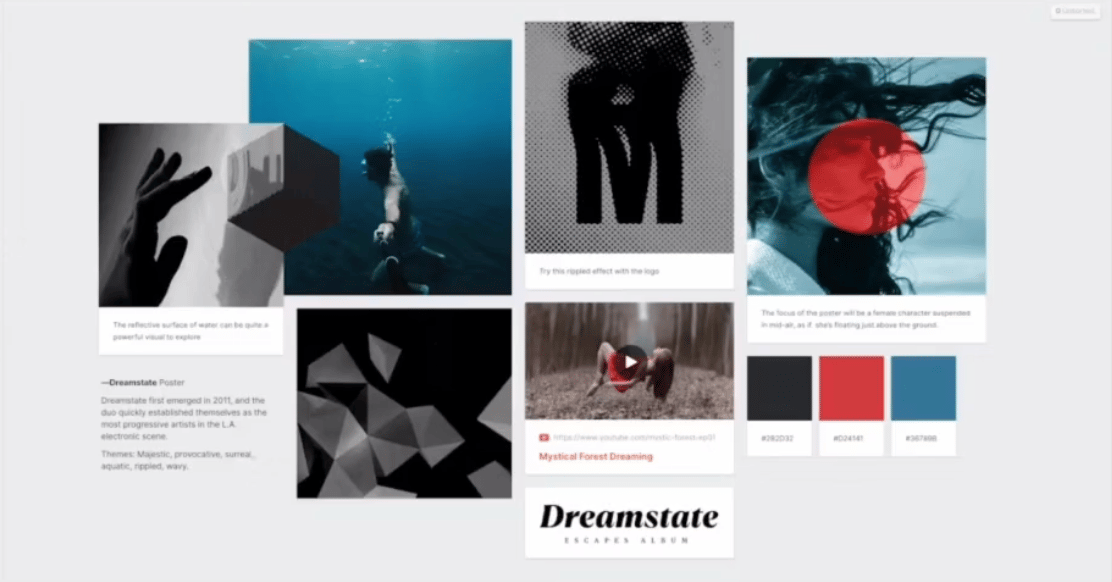
You may have thought a different one was the most vibrant image. Everybody has different ways that they see things, but when you can show people "here's what I'm looking for, here's the language I'm communicating," it helps.
Enjoying this? Forward it to a music friend you’d like to be closer to and start a discussion!
How Mood Boards Guide Your Own Work
For those of you who are like, "I don't give a fuck. I create all my own stuff."—What a lot of people do is they make a mood board, and then when they're looking at how to iterate on their songs, they look at the mood board and think, "Okay, what's gonna get me feeling closer to this?"
I did a great consultation with some members of this community a while ago. They make classic rock, closer to Jack White, but their mood board was much more like Blade Runner 2049. The reason their record is so cool is that it combines those things. They make this music that's part of that, and that's part of their mood board.
I always think of the artist M83. I have it in my book, Processing Creativity, that they'd cover the walls with a certain mood. They'd look at it to try to keep getting the feeling of "I want people to feel that way."
There's this artist I look at a lot called Simon Stålenhag. Simon makes these things where it's almost like a rotted technology, and this future we never had. This is actually one of my favorites right here.

Subscribe to Premium Subscription to read the rest.
Become a paying subscriber of Premium Subscription to get access to this post and other subscriber-only content.
Already a paying subscriber? Sign In.
A subscription gets you:
- • Read Paywalled Content
- • View Full Artist Dissections
- • View Album Rollout Breakdowns & Recaps In Full
- • Ask Lecturers Questions
- • Access To Full Unabridged Podcast Episodes
- • Discord Access
Reply