- Music Marketing Trends by Jesse Cannon
- Posts
- On Accountability & Forming Habits
On Accountability & Forming Habits
How to stay dangerously consistent and reach all of your goals.

Jesse Cannon
March 06, 2026
In partnership with

Music Marketing Trends is a Newsletter by Jesse Cannon that breaks down how musicians really get their music heard. If you know a story we should be telling or an artist we should cover just hit reply to this email.
How Jennifer Aniston’s LolaVie brand grew sales 40% with CTV ads

For its first CTV campaign, Jennifer Aniston’s DTC haircare brand LolaVie had a few non-negotiables. The campaign had to be simple. It had to demonstrate measurable impact. And it had to be full-funnel.
LolaVie used Roku Ads Manager to test and optimize creatives — reaching millions of potential customers at all stages of their purchase journeys. Roku Ads Manager helped the brand convey LolaVie’s playful voice while helping drive omnichannel sales across both ecommerce and retail touchpoints.
The campaign included an Action Ad overlay that let viewers shop directly from their TVs by clicking OK on their Roku remote. This guided them to the website to buy LolaVie products.
Discover how Roku Ads Manager helped LolaVie drive big sales and customer growth with self-serve TV ads.
The DTC beauty category is crowded. To break through, Jennifer Aniston’s brand LolaVie, worked with Roku Ads Manager to easily set up, test, and optimize CTV ad creatives. The campaign helped drive a big lift in sales and customer growth, helping LolaVie break through in the crowded beauty category.
How to Actually Build the Habits You Keep Failing At
This one's a little outside the usual scope, but it's something I keep seeing come up in consulting calls, and it's something I'm actively dealing with myself right now — so here we go.
The end of the year and the start of a new one are when most of us take stock of what we didn't do. Even if it was a good year, you know you left things on the table. And what I keep hearing, and what I keep seeing in myself, is that the problem isn't knowing what to do. It's actually doing it consistently.
The Science of Habit Formation (The Fast Version)
If you want to go deep on this, read The Power of Habit — it's the foundational book, all the science is in there, but it's long and dense. James Clear basically made a more digestible version of it with Atomic Habits, which has sold over 25 million copies. To put that in perspective, any book that sells a tenth of that is considered a massive success. If you just want the core framework in an hour, find the Huberman Lab episode on habit formation and play it at 1.25 speed. You'll get everything you need.
The short version: building a habit comes down to a cue, a craving, a response, and a reward — a loop you repeat until the behavior sticks. The cue is a specific trigger tied to a specific time. The reward is something you actually want that comes after doing the thing.
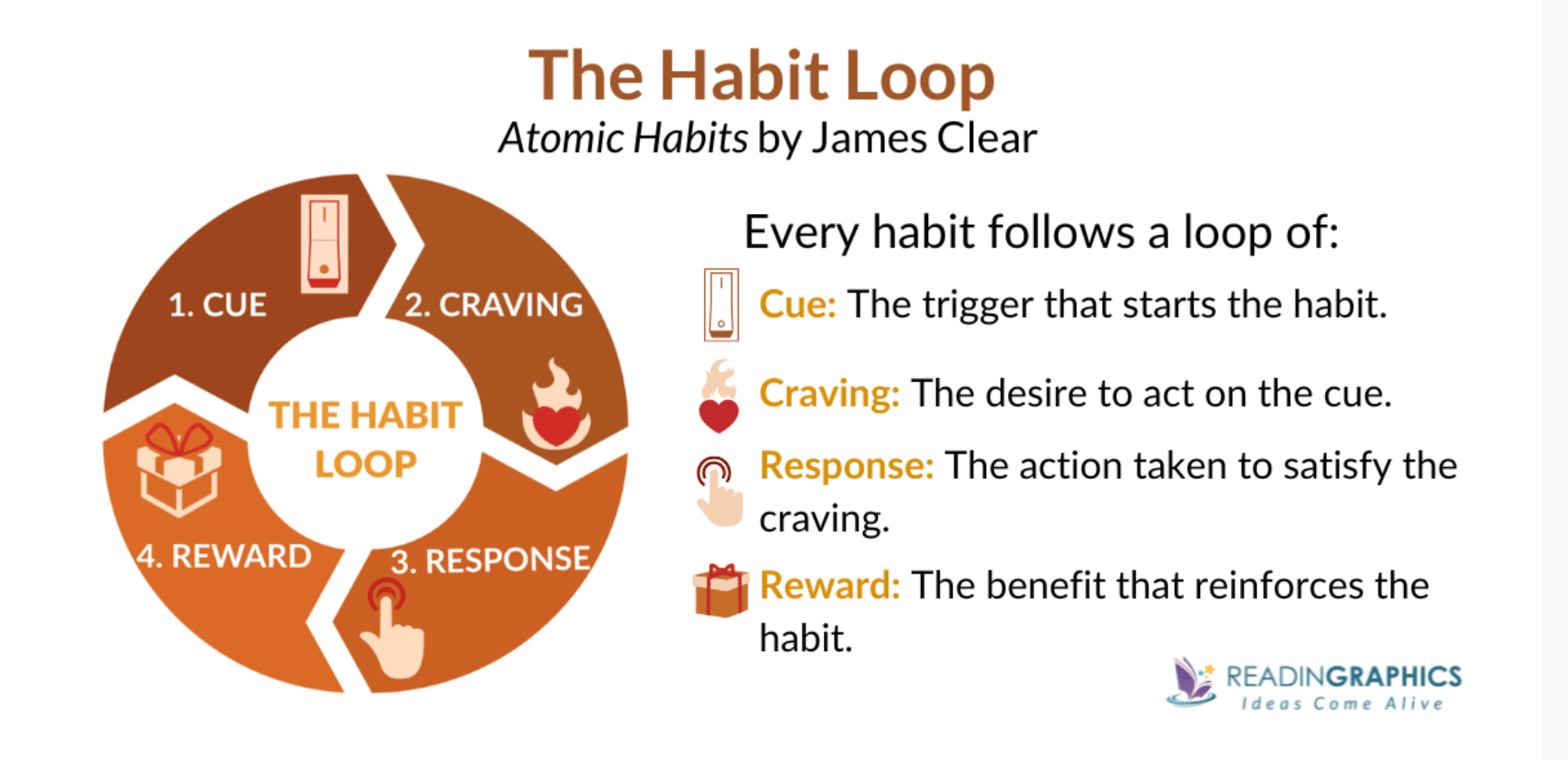
Here's how I do it personally. The last thing I do before I'm free to work on the stuff I actually enjoy each day is upload a podcast episode. I cannot do that unless I've done 15 minutes of chest exercises first. I have a reminder next to where I do this that says if I keep skipping the gym, I'm going to keep being miserable looking at myself on camera. That's the cue. The reward is getting to the work I like. The loop runs every day.
One thing worth knowing: most people do their best work in the first eight hours of the day, which is why you hear so much about morning routines. I'm the opposite — my brain comes alive somewhere between 6 PM and midnight. If you've read Daily Rituals by Mason Currey, which interviews around 200 highly effective people across history, the takeaway is that there's no universal right time. The right time is when your brain actually works, and your job is to build your life around that window instead of forcing yourself into someone else's schedule.
Reply